
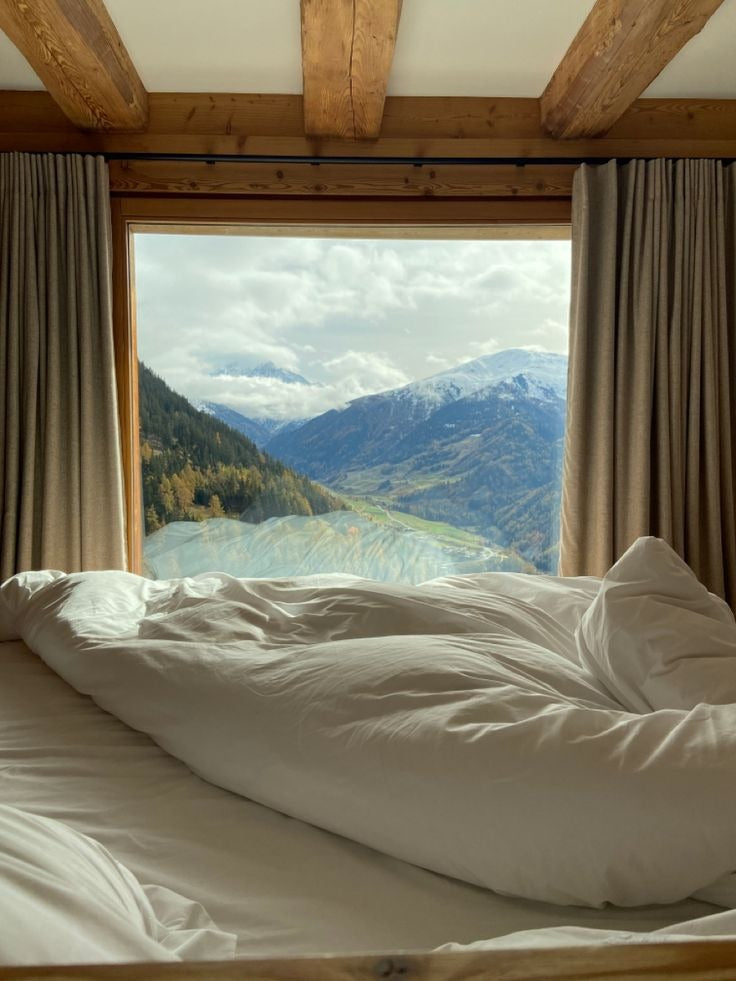
The first thing is the light. Not the lamp by the bed, but the thin seam of day that finds its way around the edge of the curtain and lies across the carpet like a ruler. In it you can read the whole intention of a room: whether someone thought about how you would wake, or only about how you would fall asleep.
A hotel is assessed many times over a stay, but the morning is where the verdict quietly forms. The evening arrival is theatre; the guest is tired, grateful, inclined to forgive. By morning they are rested and alert, and every small friction registers. The morning is also the part of a stay that is hardest to stage, because it unfolds on the guest's schedule rather than the hotel's. Nobody is waiting at the door. The room has to do the work alone.
Waking in someone else's room
Consider what the room is asked to do in those first minutes. It must let you choose when the day begins. Curtains that close completely, with no gap to betray the street lamps, are a courtesy; so is the ability to open them partway without a struggle. A room that offers only total darkness or full exposure has made a decision on your behalf.
Then there is the question of finding things. In the half-dark, a guest is a stranger in an unfamiliar plan. Where is the switch that lights the path to the bathroom without blazing the whole room? Is there a low light at all, or does every switch announce full daylight? The best rooms anticipate the walk from bed to basin and light it softly, at ankle height or from behind a mirror, so that waking can happen in stages rather than all at once.
Temperature belongs here too. A room that was comfortable at midnight can be stale by dawn. A window that opens, even a little, lets a guest take the measure of the day before stepping into it: the air, the weather, the faint sound of a city or a coastline already at work.
The sound of the corridor
Mornings in hotels are acoustically crowded. Doors close, trolleys roll, other guests leave for early flights. None of this can be eliminated, but it can be designed for. Doors that close softly, corridors that absorb footsteps, the timing of housekeeping rounds, service lifts placed away from rooms: these are decisions made long before any guest arrives, and they decide whether the first sound of the day is a slammed door or nothing much at all.
Silence is not the goal in itself. A guest does not want a tomb. What they want is for the sounds that reach them to be the right ones: birds, distant traffic, the low hum of a building waking slowly. The wrong sounds are the ones that remind you that a hotel is also a workplace, running to its own clock.
The walk to breakfast
The journey from room to breakfast is a short piece of architecture that is too often treated as mere corridor. It deserves more. It is the moment a guest moves from private to public, still half-attached to the room, not yet ready to be on show. A walk that passes daylight, that offers a glimpse of a garden or the street, eases that transition. A walk through windowless passages and a lift lobby delivers a guest to breakfast slightly bruised.
The arrival matters as much. Is there someone to acknowledge you without a performance? Is a table offered, or must you hover and choose? A good breakfast room reads the guest who wants a window and something to read, the one who wants to be near the coffee, the family that needs room to spread out. It does not ask any of them to explain themselves.
The first coffee
Everything converges on the cup. Not because coffee is the most important part of a stay, but because it is the first thing a hotel is asked to make for you, and the first thing you taste. How long it takes to arrive, whether it is hot, whether someone notices when it is finished: these are small tests of attention, and guests pass judgement on them faster than on any piece of furniture.
What is striking about all of this is how little of it is visible. A guest rarely leaves thinking about curtain tracks or the closing speed of a door. They leave thinking the morning felt easy, or that it felt slightly wrong, without being able to say why. That is the nature of care in a hotel: it is mostly unseen, and it is almost entirely felt.
Perhaps that is why the morning is such an honest measure. The lobby can be designed to impress and the evening can be softened with candlelight, but the morning has nowhere to hide. It is the hotel without its make-up, seen by a guest who has just woken and has no reason yet to be generous. A place that gets those first quiet minutes right has understood something essential: that hospitality is less about what you show people than about what you spare them.
Editorial independence — This story was written by Aura. When a piece is supported by a partner it is labelled here, and partners see no copy before it is published.
